(RULE)___WHAT ABOUT THE GIFTS OF NATURE?
“An individual should consider the natural resources as a gift from nature that must be distributed among other individuals in accordance with the elastic limit of nature, while maintaining the desire to necessity equilibrium.”
The Natural Resources (boosters)
They are free!
Natural resources in raw form must be dealt with as the boosters for societal effectiveness, i.e. considered useful if used in line with the NEPs. Their static price (i.e. in the form and place where they are found in abundance) must be zero (i.e. no one can claim to be the owner of a natural resource and take a profit on that basis; its price is determined solely by the cost of the steps it undergoes, i.e. extraction, purification, transportation, processing etc.), with only the costs of extraction, transportation, processing etc. taken into account while assigning them a reasonable status (general demand level is exempted, while the real demand is determined while taking into account the NEPs and the necessity to desire ratio) (this in turn will be helpful in maintaining the elastic limit of nature). To understand this, let’s take an example of a forest: anyone in need can go and get a tree from it, and it is up to him whether he cuts and transports it himself; if he uses the services of others for that, then he pays for the services, not for the tree. This is only possible in an ideal society, as there the resources are used only as per requirement, i.e. there is no abuse or overuse, only legitimate use. (In practice, the price of a natural resource can be checked by a step-by-step cost audit, i.e. by adding up the cost of each step it has undergone (extraction, purification, transportation, processing); anything charged beyond this sum is a profit taken for the resource itself.) Hence, the distribution among individuals is by need, i.e. each one takes as per his requirement in line with the NEPs, while which resources are drawn upon first is decided by their priority and efficiency level (discussed below).
What actually are these natural resources? Actually, a natural resource is any matter (that has mass & occupies space) that is beneficial to human beings but is not wealth (neither individual nor societal), as in the first place it is not a compressed form of the net work done by individuals. (Note that the land itself is separate, i.e. it is not counted among the natural resources; a natural resource is what is found on a land that no one owns, or, even on an owned land, what has not been attained by anyone’s work but has sprouted on its own.)
Natural Sustainability (Elastic limit)
To start with some detail, let’s define the elastic limit of nature (Natural Sustainability (NS)) in terms of the stress that we, as human beings, apply to the environment (that involves the use of natural resources). It is the maximum use of natural resources that nature can make up for through replacement and regeneration; as long as the resources are drawn within this limit, the environment recovers, while beyond it the revenge from nature begins. (In practice, this limit is checked in the same way as the Elastic limit for the Surrounding, i.e. by comparing every year how much of each resource is used with how much nature replaces or regenerates in that year; this is first reported area by area, and then combined into one overall report that takes into account the score of each area.)
Categorization of Natural Resources
We can categorize these resources in two ways:
Firstly, according to their renewability; secondly, in accordance with their efficiency level.
Natural resources can be Renewable or Recyclable.
Renewability refers to the replacement/regeneration, while recycling refers to the reuse/reconsideration of resources once dealt with.
(According to renewability) (Period of renewability is concerned)
Ø Renewability:
Replaceables (non-cyclic)
The resources that are replaceable, i.e. those that, once used, are replaced by like ones.
E.g. an apple from a wild tree in a forest is replaced once eaten.
All the self-grown tree-based food items are included in this class (burning wood from wild trees, forest-based edible living creatures etc. are also included).
(Coal, oil, natural gas, salt and rock-based minerals are also replaced by nature, but over a much longer period, i.e. thousands to millions of years, which is why they come last in the level of priority.)
Replaceables are ranked by the period nature takes to replace them: short (e.g. tree-based edibles), temperate (e.g. firewood) and longer (e.g. coal, salt, oil).
Regenerators (cyclic)
The resources that have the regeneration capability, i.e. those that, once used, return to the bulk by some kind of cyclic natural process, e.g. water used from a natural lake/river, oxygen used by living creatures for respiration (breathing) etc.
Regenerators return within a reasonable period (e.g. river and lake water), unless their cycle is disturbed by artificial means, which prolongs the period.
Ø Recycling capacity:
Reusable
The resources that are reusable, i.e. having a multipurpose capacity to interchange by processing or renewing.
E.g. iron, gold, silver, copper, aluminium etc.
They are multipurpose, i.e. having a vast range of uses. Reusing refers to either processing for a change of purpose or renewing to gain lost capability.
Reusables are ranked by their recycling capability: high (e.g. iron, gold, copper) and low (e.g. nickel, cadmium).
Reconsidered
The resources that are reconsiderable, i.e. those whose lost capability one can regain to some extent by a simple method while diverting them to other fields, e.g. radioactive materials etc.
Reconsidered resources call for a high-stake consideration before use (e.g. uranium, plutonium).
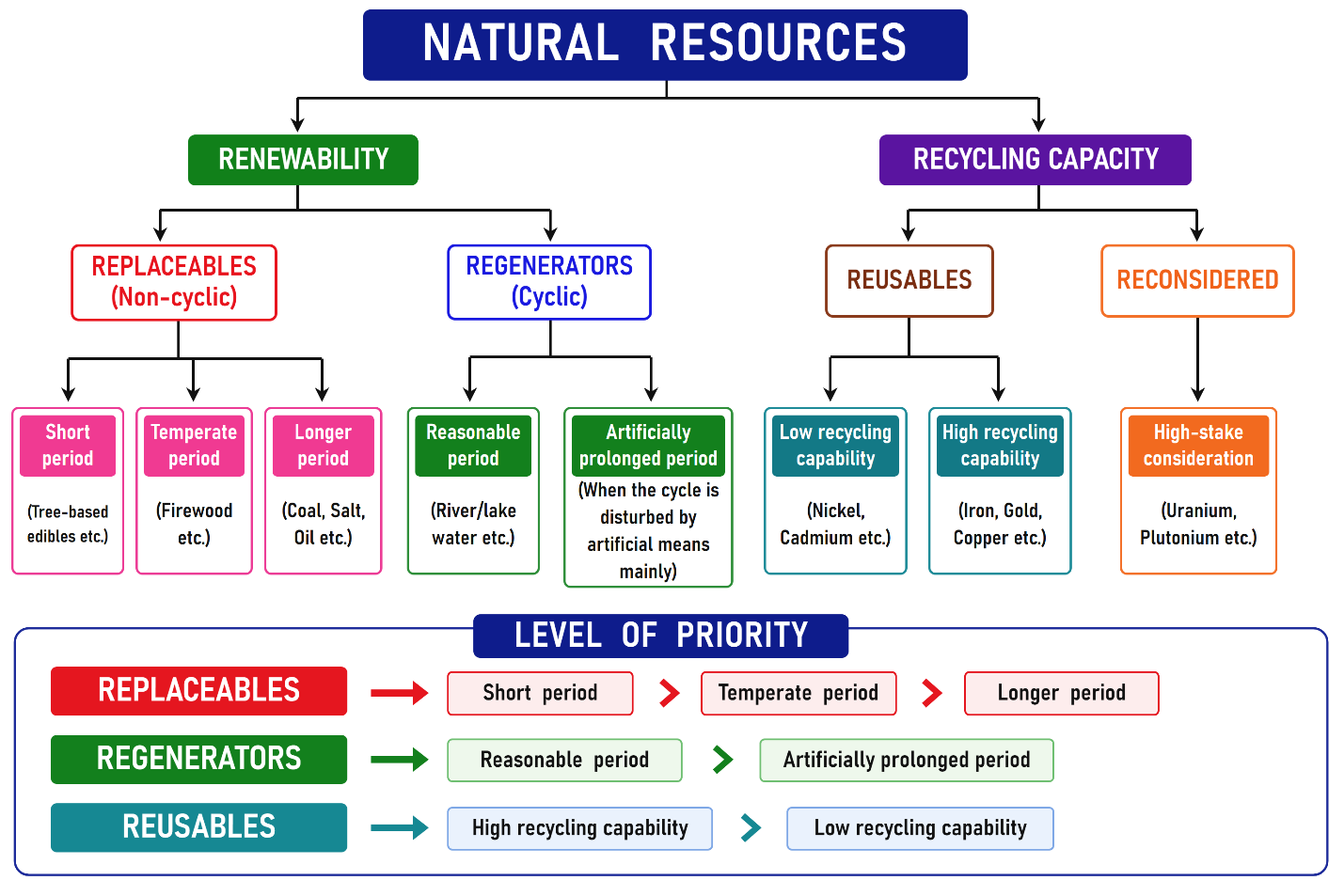
The order in which these resources are to be drawn upon is their level of priority: among the replaceables, the short period comes first, then the temperate and then the longer period; among the regenerators, the reasonable period comes before the artificially prolonged one; and among the reusables, the high recycling capability comes before the low (as shown in Chart 4).
Now, the other criterion for the distribution of natural resources is the efficiency level (this ranges from minimal to tremendous with a steady gradient).
Efficiency Level and its calculation
To calculate the efficiency level, we take into consideration the boosting level as well as the environmental shock recovery status of the respective natural source. What these two quantities signify is an important discussion.
Boosting level
Let’s start with the societal boosting level. As described earlier, the natural resources are the boosters for societal effectiveness if considered in line with NEPs; the more NEPs are covered, the greater the boosting level, e.g. if one resource is useful in shelter, food, security, peace, and clothing, then it has a boosting level of 5, while the effectiveness within the domain is represented by a positive raised-to-power form, e.g. 5^+1, 5^+2, 5^+3, and so on. This positive exponent is measured relatively, e.g. if we assign a standard resource a +1 sign, then others can be regarded as twice, thrice (+2, +3, etc.) (while the standard must be selected carefully, with the least effectiveness level, so a negative exponent is not required or is simply negligible) (this is for efficiency within one domain, while others have standards in line with this) (salt can be a standard for the food domain but can be subject to debate).
Environmental Shock Recovery (ESR)
Environmental shock recovery status (ESR status) is as important as the boosting level. In some cases, it is given more consideration, i.e. when the drastic effect is beyond the defined recovery line.
Two categories are to be discussed:
The first one is the renewables, and the other is the recycled ones (categorized on the basis of the property of nature to replace them) (renewables are replaced by nature irrespective of the time required, while recycled ones are not replaced, as nature has provided a defined amount in raw form). ESR status for renewables is determined by taking into account the gaining as well as the consumption stress.
Gaining stress
Whenever a renewable is taken from the deposit, there is a struggle to renew/reoccupy the place by the natural phenomena; this is termed gaining stress. A more complex/delayed process means a higher gaining stress level (if nature diverts more and more materials/correlated processes in the event, this means a high gaining stress).
Consumption stress
The consumption stress refers to the change imparted by a natural resource during the consuming period on the normal status of the environment (i.e. a comparison between a state of no consumption and a state of partial/complete consumption or otherwise no physical/chemical change at all).
While the boosting level is assigned positive values, the ESR status is conventionally given a negative sign so that a manageable value can be obtained for the Efficiency level.
Renewables ESR status = − (Gaining stress) (Consumption stress)
Recycled ones ESR status = − (Consumption stress)
[As the recycled ones are not replaced by nature as in the case of renewables, the gaining stress is not present in the calculation of their ESR status.]
Now, to calculate the efficiency level, we simply add the values of the boosting level and the Environmental Shock Recovery status:
Efficiency level = (Boosting level) + (ESR status)
To understand this, let’s take an example (the numbers are only illustrative): firewood is useful in two of the NEP domains (shelter and food) with an effectiveness of +1, so its boosting level is 2^+1 = 2; its gaining stress is 1 and its consumption stress is 1, so its ESR status is −(1)(1) = −1, and its efficiency level is 2 + (−1) = 1. Coal, on the other hand, is useful in the same two domains with a higher effectiveness of +2, so its boosting level is 2^+2 = 4; but its gaining stress is 3 (it is replaced only over a longer period) and its consumption stress is 2, so its ESR status is −(3)(2) = −6, and its efficiency level is 4 + (−6) = −2. Hence, despite its greater boosting level, coal is far less efficient than firewood, which is why such a resource must not be promoted to VIL. (In practice, the effectiveness exponent of a resource can be found by comparing it, pair by pair, with the standard resource (e.g. salt for the food domain), while its gaining and consumption stresses can be found through a life-cycle study, i.e. by following the resource from its extraction to its disposal and noting the change it imparts on the environment at each step.) (The efficiency levels of the common natural resources, measured on the same scale as this example, are given step by step in THE CURRENT STATUS OF THE SOCIETY, Part 5, at the end of this book.)
Note: The values of Gaining stress, consumption stress and subsequent ESR status are calculated according to some standard that can be chosen by the concerned persons as per their own preferences (however, within one society the same standard must be used for all resources, so that their efficiency levels can be compared with each other).
Virtual Inevitability Level (VIL)
This whole discussion, i.e. the division of priority level and efficiency level, is to give you the concept of VIL (Virtual Inevitability Level). This will give you (in turn) a standard as to what to do with these natural resources (how to deal with them) and provide us with an insight into how we are managing these in our current society.
As humans advanced in history, they used different natural resources to aid in their attainment of NEPs. These proved to be efficient boosters of how they managed things. Humans were even able to satisfy the threshold NEP level without these resources, and they still have the ability to do so (if they are determined as one unit), but when any one of the resources used proved to have a great efficiency level while being at the top of the priority level (although such detailed categorization did not exist at that time, trial and error provided the necessary information), it was gradually incorporated into the society to a level at which the abrupt loss of the resource could cause a compromise in the NEPs.
Resources with a greater priority status and a high efficiency level are those that satisfy the green check to attain VIL (as a simple standard, a resource satisfies the green check when its efficiency level is positive, i.e. its boosting outweighs its environmental shock, and it stands high in the level of priority), while those with a lower priority status and a low efficiency level must be regarded as hazardous/incompatible for VIL status (as said earlier, in particular cases, ESR status is the determining factor for a thorough check-up for assigning the green check status, i.e. the eligibility criteria for VIL).
In our society, resources with a low efficiency level are assigned VIL status (e.g. fossil fuels such as coal and oil, on which daily life has come to depend so much that their abrupt loss would compromise the NEPs, although their efficiency level is low), and this is exerting tremendous stress on the society and creating problems that we face both as revenge from nature and as an unhealthy competition that at times causes huge bloodshed and instability. (In practice, how deeply a resource has reached VIL can be measured by how much of the NEPs depends on it, and by testing what would happen to the NEPs if it vanished; the deeper this dependence, the more urgent the gradual way out discussed above.) (How deeply seven societies of today have brought such resources to VIL, and what would happen to their NEPs if those resources vanished, is measured in THE CURRENT STATUS OF THE SOCIETY, Part 5, at the end of this book.)
Now, to discuss the desire to necessity equilibrium in this regard, let us take a look at how these natural resources are distributed in the society. The standard that exists in our society has prevented the diversion of these resources to their appropriate position. Our desires are overwhelmingly illegitimate and huge. The more powerful are just trying to dominate others partly by the use of these boosters, and to ensure the required flow of these materials by a widespread, biased and destabilizing financial system. This disturbed balance is causing a huge compromise of NEPs, resulting in hunger, homelessness, insecurity etc. We must act now; every passing minute is pushing this world towards utter destruction.