(RULE)___THE EQUILIBRIUM OF DESIRE AND NECESSITY
“An individual must respect the natural cause of an event to maintain the equilibrium between desire and necessity.”
To respect the natural cause of an event means to keep in view why nature has placed that event in us (e.g. hunger is there to keep the body alive), and to fulfil it for that very purpose, i.e. as far as the necessity goes, rather than turning it into a pursuit of desire.
To understand this, let’s gain an insight into how nature handles different aspects of world affairs; let’s categorize these in two ways:
The first are the aspects that are directly managed by nature, while the others are those that are indirectly controlled.
Nature Sustains Life
This ecosystem is maintained by nature, and we can observe an efficiency level that is beyond calculation. Why nature decided to sustain life is perhaps a puzzle for some people, but the elements of life on Earth are universal.
The aspects that can be related directly to nature are hunger, thirst, love, maintaining security, stress-relieving strategy, survival of the species, cooperation (optional) etc. (The survival of the species is covered under love, i.e. the protection of young ones and propagation, while cooperation is covered under the organizational values; it is called optional because nature leaves it to the choice of the species, especially those capable of reasoning.)
The indirectly controlled aspects are basically related to species capable of reasoning (such as humans, at top levels) (level with respect to thinking capability among as well as within species).
The top aspect on the list in this regard is societal strategies, or organizational as well as accountability values.
Directly managed aspects
Now, to explain these statements, let’s start with the directly controlled aspects:
Hunger
Feeling hunger: (event)
Natural cause:
Several components required by the body to maintain the state of living, i.e. to sustain life.
Desire:
Taking in the food of choice irrespective of the need of the body.
Necessity:
A threshold amount / calculated amount of components demanded to maintain the normal functioning of the body.
(An equilibrium can be achieved by suppressing the desire in accordance with the endurance level.) (A person comes to know his own endurance level step by step, i.e. by holding back a desire a little at a time and noticing how far he can go without falling into psychological stress, along with the advice of his sincere relations.) (In practice, the necessity can be fixed as the basket that meets a household’s real needs (e.g. food, shelter and clothing) at the least cost, while the endurance level shows in the performance curve, i.e. the point where an individual’s output starts falling as the load rises.)
Thirst
Getting thirsty: (event)
(Similar to hunger, but keep in view that water is the drink of choice for many, so maintaining equilibrium is relatively less complex).
Love
Love: (a sensitive feeling, i.e. an event)
Natural cause:
To accomplish a wide variety of goals, including protection for young ones, reserving objects (non-living) to comfort needs and desires (for competition in the society) (i.e. the love of things, which makes one keep them aside for future needs, but which, beyond the necessity, turns into competition with others), for the propagation of individuals that have more ability (beneficial for species other than humans, while being a test for human civilization), for maintaining a level of coordination to accomplish more complex tasks (sustaining society and/or care for the weaker in terms of a lifemate, i.e. overcoming physical weakness), to increase the endurance level (overcoming stressful tasks with relative ease/comfort) and so on.
Desire:
To achieve/get everything that is loved.
Necessity:
Most of the natural causes of love (some are a test for human civilization, e.g. the propagation of individuals that have more ability, as marked above, so those must be added to the desire list).
Achieving equilibrium is a little complex and requires attention. We will divide the Necessity–Desire complex (ND-complex) into two groups (Chart 3).
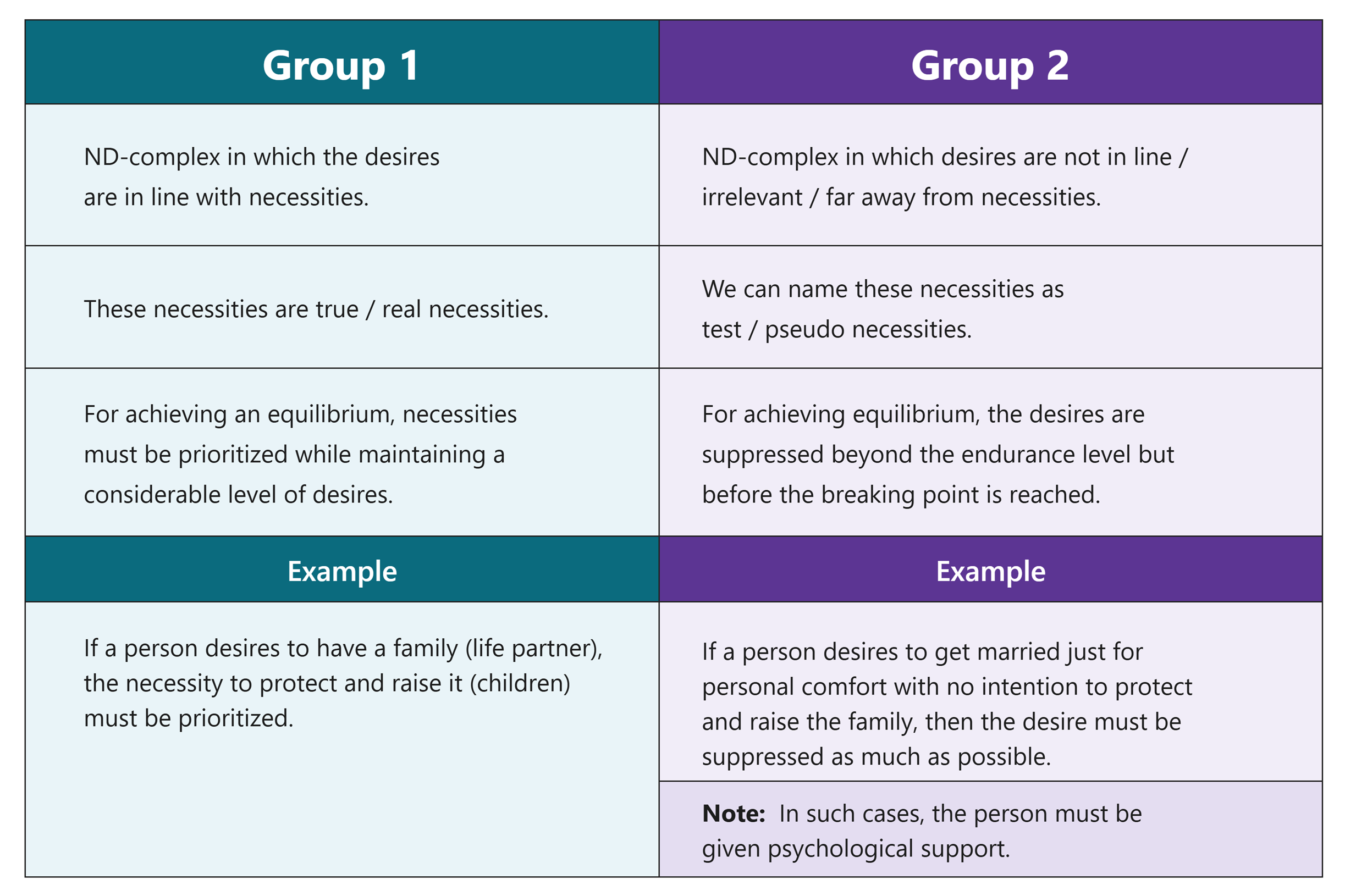
Chart 3
The Blended Ones
Maintaining Security:
An intrinsic property of an individual/living object (in general) to secure itself from environmental harms.
It’s a natural strategy for the survival of a species/individual.
Natural Cause:
To ensure the survival of the entity, i.e. to protect its integrity.
Desire:
To protect oneself at all costs.
Necessity:
To protect oneself.
(To maintain equilibrium, keep in view the moral and ethical values, i.e. protect oneself without harming the innocent, and without using more force than the threat demands.)
Note: When talking about a single aspect, we neglect the effect of others; this is to simplify things.
Stress-Relieving Strategy
The ability to minimize the effect of destructive forces.
Natural Cause:
Adaptation to the changing external conditions.
Desire:
To relieve oneself of stress.
Necessity:
To relieve oneself of stress that causes permanent deformation.
(To achieve the equilibrium, the overall burden level of the society must be calculated, i.e. through the Participation to Burden ratio, to divide it in an appropriate way, i.e. among the stress-bearing groups by rotation; see POWER STRUGGLE AND ITS PREVENTION.)
It is worth mentioning that desire and necessity are in line (related) with each other in many cases, with desire exceeding necessity in most instances, while equilibrium is a point where both are cooperative before diverging from each other.
Indirectly controlled aspects
Now, as for the aspects of world affairs indirectly controlled by nature:
These are the ones taught by nature, with little to no built-in structures to maintain them. As humans are the species with huge reasoning capabilities (relatively), we will focus on this species.
Humans have to sustain a complex structure of society to maintain security, cooperation, stress division etc. in an efficient way. It is to be noted that although these are directly controlled aspects, with reasoning capabilities, the efficiency is enhanced to tremendous levels, while we are given somewhat of a free hand in this regard, so this leads to their categorization as indirectly controlled aspects.
In this regard, we will try to understand organizational and accountability values (at the top levels, i.e. for being an integral part).
Organizational values (sustainment of the society as an event)
Natural Cause:
Maintenance of security, division of labour, efficient societal planning etc.
Desire:
To achieve the stated goals, even if done at the expense of others.
Necessity:
Maintaining a threshold level to prevent societal collapse/disintegration.
(An equilibrium can be achieved by prioritizing the strategy of benefit for all, e.g. security for everyone.)
Accountability values
These values are meant to ensure that the societal strategies are implemented to their full extent.
Natural cause:
· Desires exceeding the societal goals / set points,
· To prevent unnecessary burden on the society,
· To minimize the burden from non-ideals with a negative participation to burden ratio etc.
Desire:
No accountability for the tasks a person performs.
Necessity:
Accountability threshold to prevent the collapse of law and order in society.
(An equilibrium can be achieved by prioritizing societal gains rather than individual ones.)
Note: This explanation is deemed worthwhile because this rule has far-reaching effects and can change the individual life of a person, but there is still more that you can extract from this (i.e. the same method, finding the natural cause, the desire and the necessity of an event, can be applied to any other event of one’s own life).