(RULE)___RESPECT IS NOT COSTLY, THE INGREDIENTS ARE UNIVERSAL
“An individual must give respect to other individuals according to their worth level, with the preference gradient being the core value.”
The ingredients of respect are the qualities that every human society recognizes, i.e. caring, sharing, honesty and endurance, and each of them has its place in the structure defined so far: caring is the work done to squeeze the burden of others (as the Caretakers do); sharing is the voluntary suppression of one’s own burden by giving away a part of one’s resources; honesty is the sincerity that the preference gradient measures (i.e. the internal purity of an individual); and endurance is the endurance level that decides how far one can suppress one’s own needs. Caring and sharing build up the preference gradient, honesty keeps it real, and endurance sets its limit, while the worth level counts the participation behind them all. They are universal because they belong to no single culture, and giving respect for them costs nothing.
To understand this, we should first talk about the preference gradient:
The Preference Gradient (PR)
The quality of preferring societal benefit in order to suppress overall burden by minimizing one’s own burden while even compromising NEPs (personal) in accordance with the endurance level and working to squeeze societal burden by an efficient strategy in line with the capability level
As living creatures, we have needs to fulfil in order to comfort ourselves. When these individual needs combine, the resultant is the societal burden (the burden of needs applied by the individual to the society) (environmental & physical burden is also added).
Voluntary Burden Suppression
In determining the preference gradient, the voluntary suppression of these is taken into account primarily.
Managing Overall Burden
The second measuring standard is the work done to squeeze the burden applied by other individuals to the society. It is primarily done by persuading others to apply efficient strategies (according to the capability level of the person devising the strategy). In other words, self-suppression is downscaling one’s own burden, while squeezing means working on the burden of other people, i.e. by increasing their respect level, by encouraging them to ward off their burden, or by devising strategies that lead to the downscaling of burden on the society as a whole. To understand this, let’s take an example of a person who lives simply and gives away what he saves (self-suppression), and who also teaches his neighbours to stop wasting food (squeezing). (In practice, the preference gradient can be known through the witnesses, i.e. those who have seen an individual’s preference for others, and through observing the locality: if the anonymous giving in an area is abundant, this shows that its locals have a high preference gradient.)
Hence,



Note: In an ideal society, individuals are not forced to decrease their legitimate burden but are rather given resources according to their needs, i.e. NEPs.
So why does Respect not directly correlate with the Participation level or the Worth level?
Why not participation level?
Because the Participation level does not necessarily point towards Calmness, Peace or Integration of a society, which are the core of the Preference Gradient.
Moreover, to distinguish it from the Worth level scale, the value is not assigned directly as increased participation (as in worthful ideals); rather, the suppressed burden is the main factor.
Another reason for the selection of the burden suppression rate is to find out the sincerity of the individual.
In other words, we are determining the inner quality rather than an artificial one, because there is a high risk of gaining social status as the root cause of artificial caretaking, and thus the basis of the respect scale is disturbed (i.e. unable to find the calmness value of the society).
Increasing the participation level voluntarily is also an indirect value standard to find sincerity, but to suppress one’s own burden (NEPs) is the most direct measure of sincerity and thus more reliable for finding the Preference Gradient.
Preference Gradient for different domains
Now, to mention some details of the Preference Gradient with respect to ideals & non-ideals:
Ideals:
Normal ideals: Preference gradient can be zero or positive, i.e. zero in case they are just participating in line with the burden only because they deem it an obligation. (There is a high chance of no/negligible burden suppression with no feeling of responsibility to squeeze societal burden.) It is positive in case they prefer others and give a part of their assigned resources to others (squeezing societal burden along with decreasing individual burden) (virtually giving away their participation, i.e. some part of the resources that they were given in line with their participation, and thus having to decrease burden to make both ends meet).
Worthful ideals:
Voluntary worthfuls: [Preference gradient is positive; they are the caretakers and work for others → although their participation level (voluntarily increased) is making them worthfuls, it is highly likely that they will reduce the individual burden, and the distinguishing capability is that they work to produce more voluntary worthfuls and in turn virtually squeeze societal burden; this gives them the huge accomplishment of having a high/positive preference gradient].
Forced worthfuls: Preference gradient can be zero or positive, i.e. zero when they are participating more just to satisfy their own desires (to change group, to sustain false societal standards while accepting them, to increase social status etc.); positive when they participate more for the benefit of others, i.e. when they are doing so while being forced to accept the system without being aware of it (they are actually participating hugely, partly to the level they are forced to and partly to relieve others, but in this case the small squeeze they cause to the societal burden determines their preference gradient, as in most cases they are already being forced to minimize their own burden because they are not given appropriate resources) (such ideals are a considerable part of a non-ideal/oppressive society). To understand this, let’s take an example of a person who leaves his own society, by whatever means he can, for another that seems more prosperous; there he works far more than before, only to get a little in return. All he wanted was a life of leisure, and that is the hallucination the system showed him. Ultimately, only a few such people find a place there, while the rest stay behind, and the stealing of wealth between societies, the very thing that pushed him to leave in the first place, goes on (see Pads).
Likewise, forced worthfuls exist within a society too. The system in place sets false progress standards, i.e. wealth as the measure of success; a person who accepts such a standard tries to become wealthy, but in that very struggle he is made to participate more and more, while what he produces is drawn out of the societal pool through that very system (see Stolen Participation). The fault lies in the standard rather than in any one person, and it is the standard that has to be put right.
Non-ideals:
(Extrinsic non-ideals are assigned zero preference gradient.)
Intrinsic non-ideals: Can have a zero or positive preference gradient, i.e. zero in case their participation (if it exists) is on demand from the society, or, in case of no participation, they are accepting resources (garnered by other individuals) while at the same time terming them their legitimate right.
A positive preference gradient is true for low-participation & zero-participation cases. Let’s understand this with the help of Chart 2.
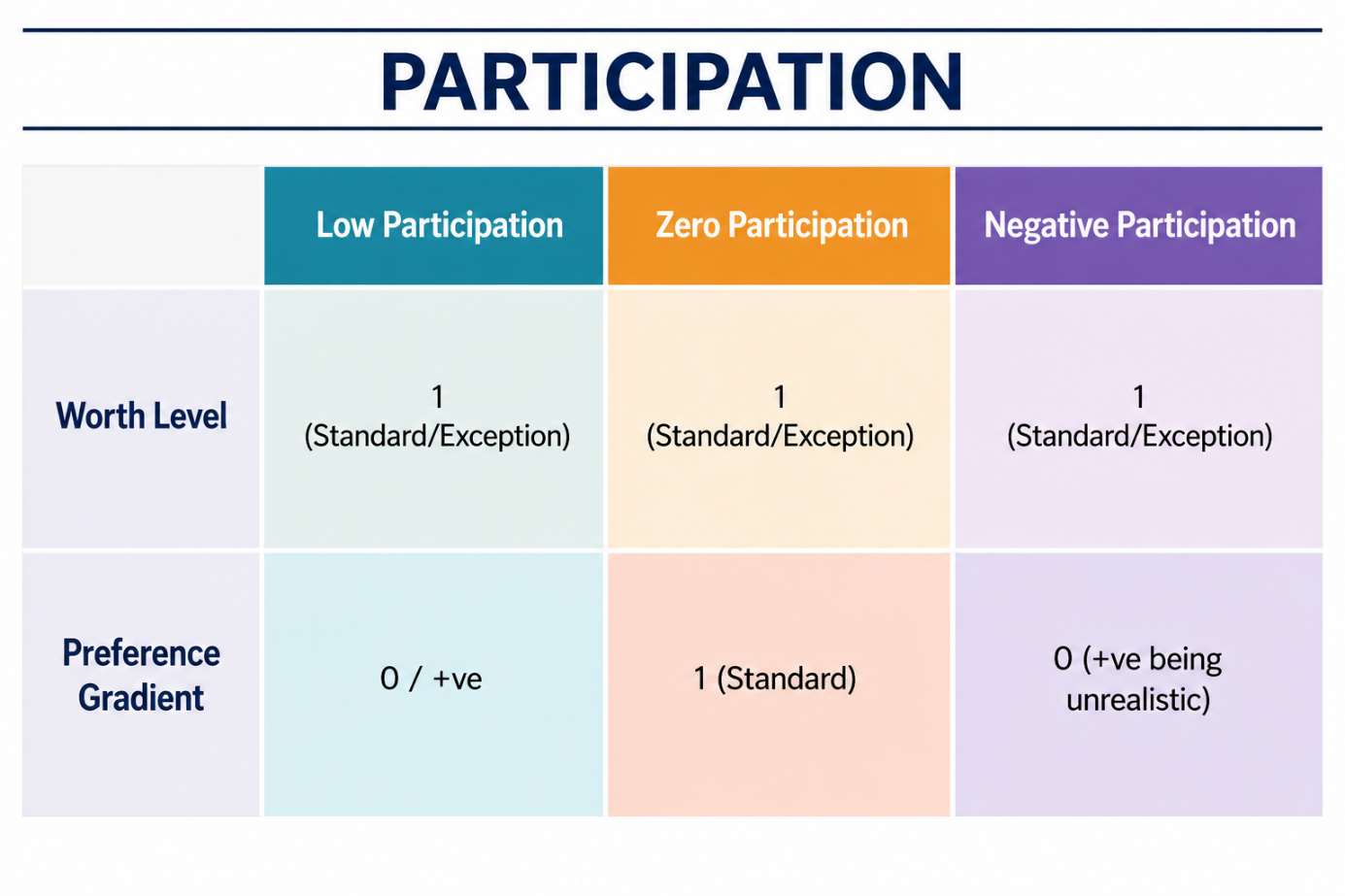
Chart 2
Low-participating intrinsic non-ideals can have a zero/+ve preference gradient.
If we take the example of old people (generally), then if their participation is for personal reasons, i.e. to remain dominant or to remain fit etc., then their preference gradient is zero (they are not fulfilling either of the two determining factors of PR/preference gradient).
If they are diverting some resources to other low-participating or zero-participation intrinsic non-ideals voluntarily, then there is a high chance of +ve PR (in this case they are indirectly suppressing individual burden and at the same time contributing towards lowering societal burden).
Zero-participating intrinsic non-ideals (e.g. the highly disabled) are assigned a standard preference gradient of 1, as they have no participation to give away and their burden is already at its minimum; this standard value integrates them as respected members of the society (just as they are assigned a normal worth level). It falls to zero only in the case mentioned above, i.e. when they accept the resources garnered by others while terming them their legitimate right.
In the case of negative participants, PR is zero, i.e. a +ve value is not realistic, as they are occupied by excess desires, so they are increasing individual as well as societal burden.
Respect Value scale
Rebuked —— Normal status —— Respected
(Extrinsic non-ideals etc.) (Worthful with zero PR) (+ve PR worthfuls)
Respect value = Preference Gradient × Worth level
(Note that both the rebuked and the normal status have a respect value of zero, but for different reasons: the rebuked ones have a worth level of zero, while the normal ones have a positive worth level but a preference gradient of zero; hence the respect value alone does not separate them, and the worth level has to be looked at as well.)
Theory of the ultimate kindness cycle:
(It states that if a society succeeds in attaining a specific combined successful respect level, then a cyclic cascade of kindness is eventually achieved.)
Now, to understand it, let us take an example of a society that has +ve respect level individuals along with a small (relatively) group of 0 respect level bearing individuals (but there must be an overwhelming number of worthful individuals). (The specific combined respect level is reached when the resources given away by the individuals with a positive respect level exceed the resources kept back by those with a respect level of zero, i.e. more resources flow into the passing chain than drop out of it; this is why the zero group must be relatively small.) (In practice, this level can be found by starting the same gifts in a few neighbourhoods with different numbers of Caretakers and watching which of them keep cycling; the neighbourhoods where the cycle keeps going show the threshold.)
What happens is that resources are being passed over and over with virtually no one to use them, thus causing kindness to dominate the society, with this passing procedure increasing trust at every level.
To make it easy, consider that a respectful individual is caring for other participants of the society and thus gives away some of his resources (destined for him due to the participation he made) (virtually decreasing individual burden). (The first step is always taken by the voluntary worthfuls, i.e. the Caretakers, as giving without waiting to receive is their very nature; the others join the chain as the resources reach them.)
At the same time, he receives more resources from another respectful (of the same or a higher respect level), and the one to whom he gave the resources in turn gives away more resources to another respectful. If, step by step, this reaches an individual with 0 preference gradient (but +ve worth level), then he will transfer it further (as it is beyond his need). And what about the one who keeps the resources and does not pass them on? Actually, he is the one with the least resources, i.e. the eligible person who does not ask others for help; in this cycle he is taken care of, while nobody calls him a beggar. Keeping them does not make him a bad one, as he is a worthful person (see ARE YOU A WORTHFUL PERSON?), e.g. an intrinsic non-ideal who cannot reach the required participation level, and he keeps only what he needs. To understand this, let’s take an example of an old man who lives alone and never asks anyone for help: the tomatoes passing from door to door reach him too, and he keeps them as he needs them, while no one looks at him as one who begs.
This process is turning zero respect level individuals into positive ones; this cascade is an everlasting cycle that is spreading kindness in the society and thus a key element of “The Earthly Heaven”.
Just think of it: you gave one tomato to your neighbour and received 10 at your doorstep; then you shared more but got exponentially more (this is a sign of a society whose individuals are caring and kind).
What does the overall Respect level signify?
Now, let us briefly define what the worth level scale and respect level scale tell us about the society.
Actually, the Worth level scale determines the sustainability of the society, i.e. whether the society is flexible enough to endure stress, is under stress or is nearing collapse, while it also tells us the amount of stress that can be applied to the society without crossing the breaking point / point of no return / point of permanent distortion.
The Respect level scale tells us about the calmness of the society, the peace level, the integration level of the individuals, the progress level, the kindness level, the reliability of the society, the happiness level, the cooperation level, the trust level, etc. (In practice, the overall respect level of a society is worked out from the respect value formula itself, i.e. preference gradient × worth level, taken over all its individuals, with the preference gradient known from the witnesses and the locality, and the worth level from the hours of participation, as discussed above.) (The overall respect level of seven societies of today, worked out from this formula, is given step by step in THE CURRENT STATUS OF THE SOCIETY, Part 4, at the end of this book.)