(RULE)___ARE YOU A WORTHFUL PERSON?
“An individual must be assigned a worth level in accordance with his participation in the society.”
Exception: Extrinsic non-ideals should be regarded as worthless (especially ones with a negative participation to burden ratio, i.e. worth level is either zero or positive, while a negative worth level does not exist for participation-related cases).
Although a participation level may exist in the case of extrinsic non-ideals (but the burden level will override it), a positive worth level is not assigned to them, i.e. they are discouraged.
Note: Intrinsic non-ideals are assigned a normal worth level.
As for those extrinsic non-ideals that have lost participation efficiency due to an accidental cause, they must be encouraged to participate as much as they can (they should be assigned tasks that fit them the most). (Note the difference: if an accident takes away the capability itself, e.g. a disability that rules out the work, the person is an intrinsic non-ideal (artificial cause); if the capability remains but his efficiency or will to participate is lost, he is an extrinsic non-ideal (accidental).)
To make it clear, let’s take examples:
If person 1 is a normal individual, then, having the same participation level as other ideals, he is a worthful person.
If person 2 is an extrinsic non-ideal (accidental), then, as the participation level is manageable, he should be regarded as a worthless person to encourage participation (i.e. his worth level stays at zero only until he participates, while he is helped with the tasks that fit him; as soon as he participates, he regains the normal worth level).
If person 3 is an intrinsic non-ideal (lacking the natural capability to participate at the required level), then, as the participation level cannot be achieved, he is a worthful person (to integrate him as a normal person).
Worth level for different Domains
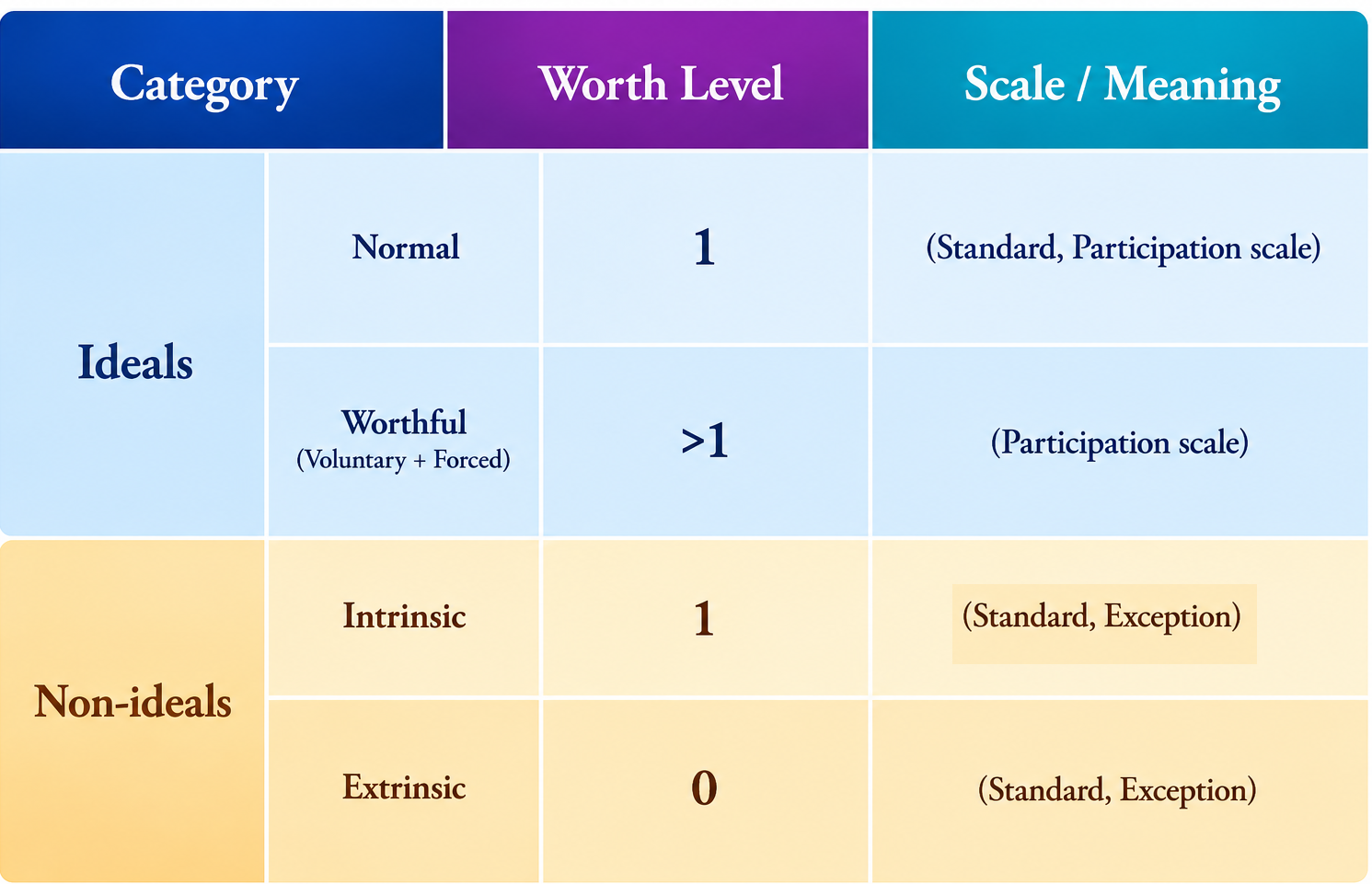
Chart 1
Overall Worth Level and its significance
The overall worth level of a society is the total hours that its capable adults give to the NEPs (the work of the worthless, i.e. the extrinsic non-ideals, not being counted, as their burden overrides it), divided by the number of its capable adults. It is read against the required set point, i.e. the hours needed from each capable adult to cover the NEPs: if it is above the set point, the society has spare participation, enough to accommodate its non-ideals and to endure stress; if it is close to the set point, the society is on the edge; and if it falls below the set point (as extrinsic non-ideals increase), the society comes under stress, with more and more of its burden carried by forced worthfuls. However, a low overall worth level alone does not mean that the breaking point has been reached, as other factors also have to be accounted for (see what the worth level scale tells us under RESPECT IS NOT COSTLY, THE INGREDIENTS ARE UNIVERSAL).
Now, to enumerate people with an increased worth level: these are the people who voluntarily exceed the participation level (beyond the required set point; Voluntary worthfuls; The Caretakers). (An individual’s worth level is the hours he gives to the NEPs, and theirs rises above the required set point in proportion to this excess; for example, where the set point is 30 hours a week, a person who gives 45 hours a week to the NEPs carries one and a half times the required participation.) (In practice, the required participation level can be fixed as the total hours that the society needs to cover its NEPs, divided by the number of its capable adults; the overall worth level is then reported along with the share of individuals below the set point.) (The overall worth level of seven societies of today, worked out in this way along with the share of individuals below the set point, is given step by step in THE CURRENT STATUS OF THE SOCIETY, Part 3, at the end of this book.)
The Caretakers:
The people who care for others, people who give priority to others, people who consider it their responsibility to participate on behalf of intrinsic non-ideals, people who are ready to sacrifice their needs for others, people who live for others, people who are optimistic and believe in equality, people who are the assets of a society, people who become happy/feel pleasure by providing relief to others, and people who have a high endurance level.
Normally, nature maintains their level greater than that of intrinsic non-ideals (i.e. in a society left to its natural balance, the Caretakers always outnumber the intrinsic non-ideals, so that everyone who cannot participate has someone to participate on his behalf; just think of a newborn, who comes into a family with parents and relatives ready to care for him).
Today, in our society, we are witnessing a shift in this balance; the reason is that the worthful ideals are not assigned the right worth level. The judgement of individuals is based upon the status they bear in the society (those participating in areas other than NEPs are designated as more worthful). As a result, people are drawn away from the NEPs towards the areas that bring status, and the core of the society (i.e. the participation in its NEPs) is getting weaker and weaker. To understand this, let’s take an example of a young man who could become a good farmer or nurse, but chooses a career that brings fame instead, because that is where the status lies; likewise, when most people make the same choice, fewer and fewer are left to carry the NEPs. The educational system does not teach people to work for others (generally/dominantly); rather, people are taught how to gain status in the society. As the intrinsic non-ideals persist while extrinsic non-ideals increase, societies are struggling to produce more forced worthfuls, which in turn is spreading chaos in the society and an outpouring of struggle to dominate others by becoming extrinsic non-ideals.
Naturally, there exists a slight margin so that extrinsic non-ideals are accommodated, but the space is not huge; hence the ideal society suppresses the number of extrinsic non-ideals as much as possible.
Now let’s discuss forced worthful ideals. These are ideals who are forced to participate more than the standard participation level.
In an ideal society, these must be virtually zero. As we are not an active part of an ideal society, we shall take a look in accordance with our current societal structure.
As discussed earlier, the balance of voluntary worthfuls and intrinsic non-ideals is being disturbed by our artificial destructive intervention, so in turn forced worthfuls have to be increased in order to sustain the societal needs.
To enumerate some such individuals:
The Tissue Papers:
People in the oppressive group, people with a low capability level / the ones at the lower levels of societal organization, people who accept the false worth levels and hence feel compelled to sustain such a structure, people with a high desire value (far from NEPs) while being unable to muster resources accordingly, people under the illusion of false progress standards, people struggling to change their group from oppressive to dominant, and people with the aim of increasing societal status for personal reasons etc.
Note: Their excess participation is in accordance with NEPs; as discussed before, any other participation is not considered while assigning the worth level.