(RULE)___IS RETRIBUTION ESSENTIAL?
“An individual should be retributed or reprimanded in accordance with the guilt, while the main goal is to retract the source causing the destruction along with diluting the disturbance and preventing further expansion or propagation of new sources.”
What actually is guilt?
Evil, like weeds in a farmland:
Evil is like weeds sprouting in a farmland, which are always a challenge for normal crop production and thus must be cleared with time. Likewise, evil practices emerge in the society from time to time and, if left unchecked, gain momentum, and the result is the destruction of the entire society. The sources that make these evil practices flourish are to be recognized and eliminated as soon as possible (i.e. before they can establish a foothold and propagate roots deep inside the society). This must be accompanied by the removal, with as much efficiency as possible, of the disturbance caused by the evil/unethical practice. Then comes the precautionary measure to prevent any related sources from flourishing afterwards.
Severity of Guilt and the Retribution amount
The severity of guilt is determined by the degree of disturbance that is produced in the society (ideal), i.e. the more the disturbance, the more severe the guilt. (Disturbance includes the subsequent strengthening of the source that produced it, while also taking into account the new sources that emerge afterwards.) So, what actually is this source? In fact, there is no hard and fast rule to determine it, as any condition or circumstance that leads towards the guilt is actually the source, and its determination is done from case to case. (Once the severity is determined, the retribution is taken accordingly, irrespective of the cause or the source that provoked it.) (This is because the disturbance level is the point of consideration in this regard.)
How must the Judge give a verdict?
To understand the whole process, let us consider a case scenario (in which a judge is to analyse it and decide on a verdict): A car was stolen from the parking lot of a rest area on the highway. The criminal was apprehended a few hours later and produced before the court, where he was declared guilty on the basis of appropriate evidence.
Now, for the judge to identify an appropriate retribution, he must follow this procedure:
Degree of Disturbance (Step 1)
Step 1: Determine the degree of disturbance caused in the society by this act. This can be done by taking into account some aspects to be discussed here:
Provocation amount
Provocation amount, i.e. how this act affected the perception of other individuals in the society about the guilt (the degree of change in reluctance, i.e. whether they became relatively more inclined towards doing the same action or did not care at all). There is always a designated value for the society that is the threshold, while it varies from culture to culture. Every culture can determine the increment by extensive study. (This includes the retribution level and the subsequent level of eruption of other motivated cases.) (Usually, by increasing the retribution level, the level of eruption of future cases diminishes.) (This must be tuned to a manageable value such that there is no illegitimate retribution, as this can spread chaos in the society.)
Security Shock
Security shock, i.e. the level at which the security status of the society is disturbed. Whenever an out-of-line action (evil/unethical) takes place in the society, other individuals demand security changes to prevent the same from happening afterwards. This demand is in fact another criterion for determining the severity of guilt. If more and more people are feeling unsafe, then this means the severity level of the guilt is increasing. (It can be measured by the rise in the demand for security, e.g. requests for guards, cameras or patrols in the affected area, before and after the act.)
Psychological depression
Psychological depression, i.e. how much those immediately affected suffered psychologically due to the evil/unethical action (measured according to the sensitivity status of the concerned individuals) (although a reference value is preferable, because it is a manageable one, as determining the exact psychological depression status is at times challenging and requires great cooperation from those affected).
Material damage
Material damage, i.e. how the act caused the material damage:
(on the basis of reversibility)
(Is the damage reversible or not, and if reversible, then how many resources are to be diverted to fix it?) If the damage is irreversible (i.e. loss of life or of any body part), then there should be a strategy of stone for stone or the replacement method.
Stone for Stone (SFS)
If you think that the stone for stone strategy disturbs the guilt–retribution balance, then just look at the destructiveness of other methods that are applied in the society. It's true that no matter how much retribution is in place, the damage is irreversible, and truly, in such cases, we are not concerned with replacing the material damage, as we cannot do that in reality. The only solution is to prevent further cases of such magnitude. If you came to know that there was a robbery in the house next door and the resistance by the house members led to the death of one of the members (let it be a father, mother, sister etc.), and the criminal was apprehended days later, then what would you suggest about the punishment that should be given to the criminal? Would you suggest that the person should be freed at any time later (let it be even 25 years) while he intends to return to the guilt? Would you feel safe if he were roaming freely? Life imprisonment is not the solution, as it doesn't provide the required threshold to stop a considerable influx of future cases (if you really feel that the person truly intends to leave the wrong way and adopt a normal life, then there is a replacement method available).
Comparison (SFS vs TDM)
To understand it another way, let's compare two methods of dealing: one is stone for stone (SFS), and the other is the Threshold Deficient Method (TDM), one that does not satisfy the minimum threshold for preventing future cases (by far, there is no effective way other than the SFS strategy) (the replacement method has a limited scope and is largely a way to deal with special cases).
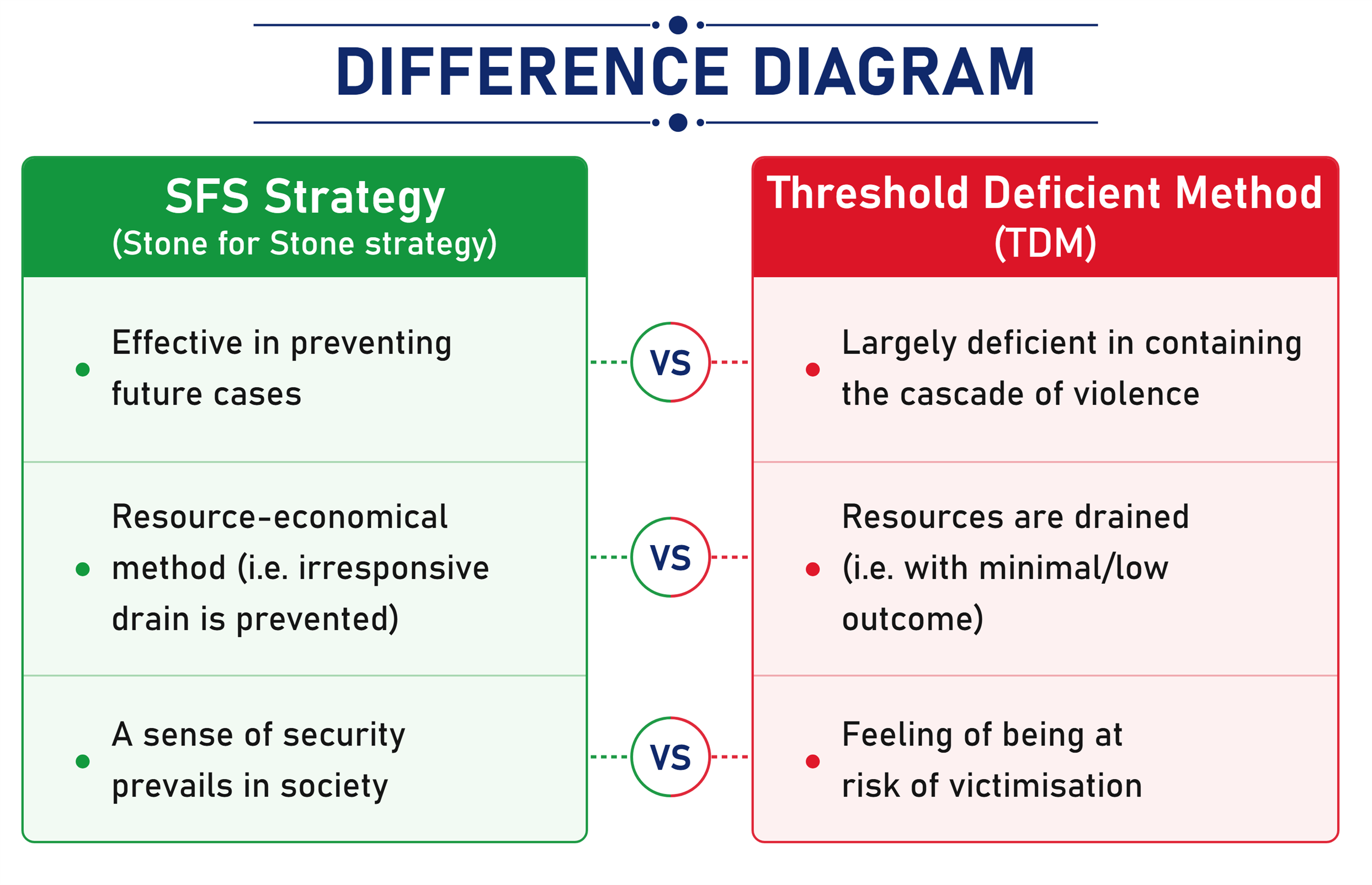
Chart 5
A reasonable person can easily conclude that it is better to take vengeance on a criminal to save a hundred lives (simple math ratio) rather than to preserve a criminal and put a hundred lives at risk (it’s simple). (In practice, the effectiveness of the SFS strategy defines itself, i.e. its results, the number of future cases and the sense of security in the society, settle the matter on their own; however, these results can only be achieved when the retraction of the sources (see Step 2) is carried out alongside.)
Replacement method
The replacement method is an appropriate extraction of a price for the apparent replacement of the irreversible damage. This is suitable only in cases in which the criminal has the capability to return to normal (while the provocation amount and security shock are both manageable or simply minimal) (the returning capability can be judged only by the past activity record or by keen observation) (but at times the provocation amount is the value of more concern).
Now, let us continue with the material damage point:
(on the basis of involvement)
It is taken into account whether the damage was a direct result of the actions of the guilty person or whether it was indirect, i.e. a middle agent or source is present.
Usually, direct damage represents a more severe guilt (this is valid for a confined affected area or scope). In cases where there is a huge difference between direct & indirect damage for the same guilt, the severity is assigned according to the scope or area that is affected (Charts 6 and 7).
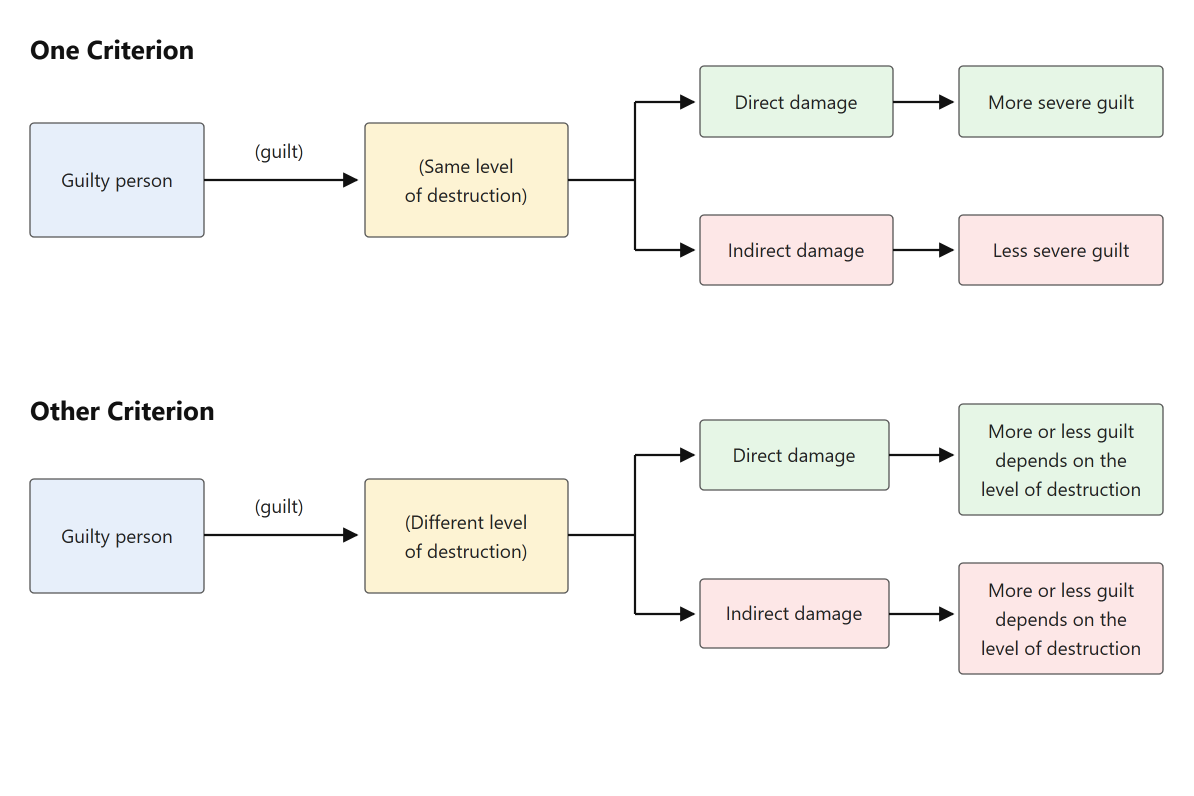
Chart 6
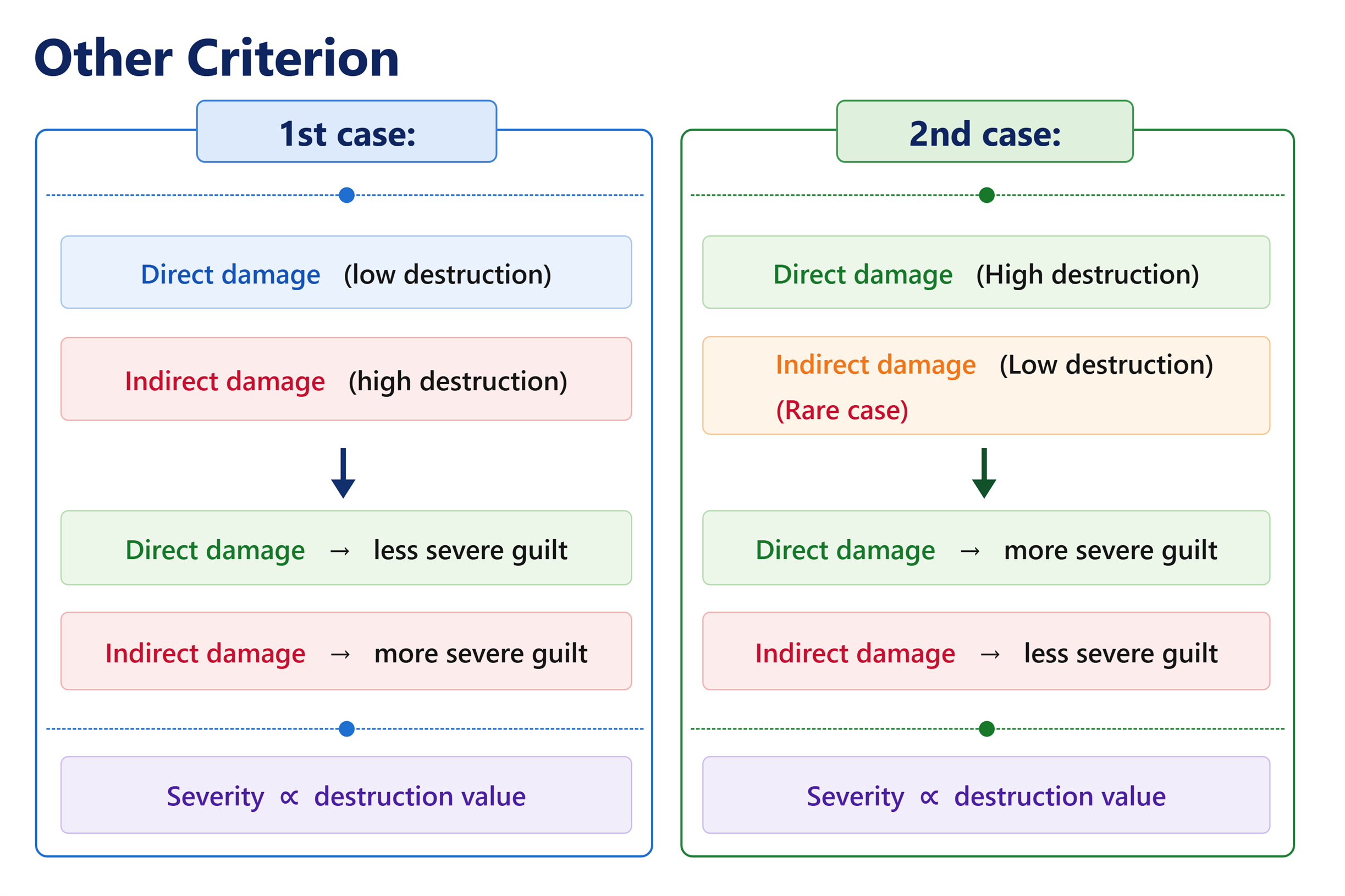
Chart 7
It is to be noted that a guilt can either be a Uni-Damage Case (UDC) or a Bi-Damage Case (BDC): UDC if the material damage is either direct or indirect, and BDC when the material damage is direct as well as indirect (in BDC, the retribution for both damages is taken separately, i.e. the two are added together).
Retraction ability
Retraction ability, i.e. the natural capability to retract and continue the normal path. There is largely a constant value that nature has programmed into our very foundation (while there exist outliers with an increased value). There exists a variety of viruses that have the ability to corrupt the programme and disturb the normal functioning, causing an error or a complete shutdown. The criterion is that the lower the value of retraction ability, the more severe the guilt, and hence more retribution is suggested. Now, what are these viruses? Actually, there is a wide variety of them, and in fact these are the effects caused by a source that leads towards the guilt. (In practice, each of these aspects can be measured: the provocation amount by the rise or fall of similar cases afterwards, the security shock by the rise in the demand for security, the psychological depression on a standard scale against its reference value, the material damage by its cost, and the retraction ability by the past record; these scores are then combined in one published grid with agreed weights, so that similar cases receive similar retribution, and the grid is audited every year by comparing the verdicts of different judges in similar cases.)
Determining the Source (Step 2)
Step 2: Determine the sources (or source) that lead to the guilt. (In practice, the sources can be traced by asking ‘why’ step by step from the guilt back to its root, by comparing the circumstances of those who committed such a guilt with those of similar people who did not, and by mapping where such cases gather, i.e. their hotspots; any computer analysis can only point to a lead, never prove a source.)
Nature Shields the Sources
It is the most important task, as this may possibly be a hunt for the beast. Guilt is almost always a result of a compromised retraction ability, or simply, we can say that a person is not born with guilt. There are circumstances or conditions (even events) that are the root cause. Basically, these sources exist in nature, but the retraction ability that is naturally maintained shields their effect, though only up to a limit. If we artificially create more and more sources or simply exaggerate the effect of already present sources, then this leads to a compromise in the retraction ability and eventually results in the occurrence of a guilt.
Let's understand through the immune system
To understand the whole process, let’s take the example of the working of our immune system. Let us suppose the reservoir (where potential pathogens are taking refuge and easily multiplying by using the resources available while maintaining their integrity) is the source, while the pathogens are its elements. These pathogens made their way into our body (portal of entry), surpassing the first line of defence. The strength of the immune system is the retraction ability. The more powerful the pathogen is, the more stress is applied to the immune system. If initially the system is struggling, then the symptoms arise (the conditions arising in a person before the occurrence of guilt) (the second line of defence is under immense pressure). If the condition persists, then there are two possibilities, i.e. either with time the third line of defence intervenes and successfully eradicates the pathogen (the optimistic thinking nullifies the situation) or the whole immune system collapses (the person executes the guilt).
Just as our immunity maintains an overall calm (most of the population is doing well in terms of health unless there is a considerable outbreak) (this is valid only for a moderate lifestyle), the retraction ability maintains an overall calm in the society (disturbances may occur but they are overcome before any major destruction) (it is to be noted that, unlike disease pandemics, the retraction ability in natural circumstances only faces a constant influx of sources that are generally overcome).
In our society, we are the responsible entities that have exaggerated the strength of existing sources, while there is also a high influx of emerging sources. A disturbed desire to necessity equilibrium (unethical desire fulfilment), a dangerously decreased level/amount of respectfuls, a disturbed guidance standard, etc., are the driving causes of the exaggeration of existing sources, while immoral technological abuse, disastrous dominative strategies, and corrupt system regulation are some of the driving causes of the eruption of new sources.
Retribution is important, but the retraction of sources (i.e. minimizing the effect of existing ones while eradicating artificial ones) is crucial. Treating the wounded is essential, but destroying the killing machine is crucial.
An appropriate retribution (Step 3)
Step 3: Give a verdict as an appropriate retribution or reprimand for the guilt while ordering the retraction of the source that caused it, such that the related sources are also investigated and brought under consideration. (The retraction itself is carried out by the capable governing individuals responsible for that area, as the judge only orders it.)
Coming back to our case of the stolen car: the car was recovered, so the material damage is reversible (the cost of any repair is extracted); the provocation amount and security shock are moderate, as travellers now feel less safe at rest areas; the psychological depression of the owner is taken at the reference value; and it is a UDC (direct damage only). The verdict is therefore a retribution in line with this moderate degree of disturbance, along with an order to investigate the source so that it can be retracted.