(RULE)___GUIDANCE AND ITS GUARDIANS
“An individual must provide guidance to others in accordance with the Guidance Law, with priority being given to the retractor in line with the level of error.”
The basis of guidance
One of the most important aspects of societal integration is the degree and standard of guidance of its participants. Every person is distinct from others (the level of distinctness may vary) and perceives the societal norms differently. Most agree to live in a way that correlates their personal preferences with the societal law. From the early ages to the most advanced ones, a person learns a lot from knowledge and experience. This amalgam is the basis of guidance, which shapes the social life of an individual, which determines the course of action, and which indicates the effectiveness of a society. As appropriate and timely guidance is essential, a delay or absence can be lethal and make it difficult to engage at a later stage.
The Guardians
An Ideal Society is necessary
The question arises as to who is eligible for this important task of guidance. Every worthful individual is a candidate, while selection depends upon the capability level and social status. (No one appoints them; by the Guidance Law itself, every individual is a guider for those of the same or lower capability level and social status.) (This standard is only valid for an ideal society.) Before we proceed, let's assume a society in which every individual is assigned a position in the stratification of the society (recall that society is like a stratified structure) in accordance with the capability level (natural capability + degree of flourishing) tuned with the interest level. The Work-position similarity theory is one of the core values for individual satisfaction (at the designated position).
Wealth and social status are in a real sense detached from the capability level (as for wealth, it is considered an extra responsibility as a guardian, while the more capable are reluctant to take it as their own; actually, in most cases, wealth is a matter of regulation done largely by these capables, but they are not the real owners, i.e. either they take it voluntarily as caretakers or are hired by others) (as for social status, it is primarily determined by the preference gradient, which means high social status individuals are undertaking extra responsibilities to relieve societal burden, while their own burden is also decreased in this standard; it is recognized through the trust of the people around him, i.e. those who have witnessed his preference for others over time).
Now, as we know how social status and capability level work in the society, it is easy to determine the selected individuals and the scope of their guidance. The Guidance Law gives us a blueprint of the basic standard.
The Guidance Law
It states that:
(Reasonable guidance is the one provided to the individual by another entity with the same or higher capability level and social status.)
In an ideal society, most individuals are selected guiders, to the extent indicated by the Guidance Law. In this scenario, an environment of brotherhood is created in which stress is relieved from depressed people, and sound mental health of the bulk is the subsequent achievement.
The caretakers blossom, and there is always a helping hand that can guide you whenever and wherever you are in need. In our society, people want to be followed by everyone. They are neither the guiders, nor do they have the standard level to be (the basic capability value and social status ingredients are the corrupt ones, and the majority of the upper class are selfish and try to maintain their false status by every evil/unethical means they can find). People are guided so as to achieve personal benefit and largely taught social norms by exploiting their desires. In short, people are guided to the verge of chaos, and they just jump into it by considering it to be the right thing to do. In reality, none can benefit from this whole process, but they are blind to it. Still, we can change things, but as time passes with this Hell in place, every minute is adding to the cost of achieving the ultimate redemption.
Levels of error
To briefly define the level of error, it is divided into three levels: the first level includes a compromise that is confined to one’s own boundary (an immediate deviation from essentials that has high individual risk but low to no societal risk). The second level includes a compromise that affects both the individual and the society, i.e. high individual risk and medium societal risk. The third level includes a compromise that is lethal to the individual and poses a great threat to societal sustainability, i.e. high individual risk as well as high societal risk.
Level 3 error
To discuss some details, let’s start with level three: it is when the actions of an individual threaten society and one’s own self. It usually affects the people at high positions of societal organization, but cases are also suspected among medium to lower position holders. What does this error mean? It should be kept in mind that these errors are not guilt, i.e. these are not wilful errors [the person is sincere towards his concerned moral and ethical values, but things are not well in place due to a knowledge deficiency (useful and relevant knowledge), while a lack of appropriate experience can be another cause]. These third-level-bearing people include those individuals who are perception moulders (especially the ones handling mass communication means) (e.g. media persons, writers, poets etc.) (they must not be agents, i.e. working on behalf of some destabilizing entity, but the error is a result of a lack of reality-based facts / on-the-ground situation, while not having the experience to analyse the data to reach a comprehensive result). They are given more priority for guidance compared to level two or level one error-bearing individuals. Their guidance is provided by those of equal or higher capability in their own field, by sharing reality-based facts and the on-the-ground situation, and by giving them the experience to analyse such data.
Level 2 error
Level two error corresponds to high individual risk and medium societal risk. It usually affects the people at medium positions of societal organization (the managing class, i.e. the people who are mostly concerned with implementing the strategies rather than devising them). This error-related division is based on the amount of effect that is imparted on societal effectiveness rather than on direct measurement of the intensity; this is because doing so involves deep complications, and a vast number of standards may erupt to satisfy different points of view. Now, to discuss the people who are susceptible to level two errors: these are the local leaders (family elders, group regulators, area invigilators, prominent commentators, advisors etc.). They are given more priority for guidance compared to level one error-bearing individuals. Their guidance comes from the capables at the organizational level above them, who explain the strategy behind the tasks they implement.
Level 1 error
Level one error corresponds to high individual risk and low to no societal risk. Virtually every individual can be the bearer of such an error, but diagnosis is relatively difficult, as there is no apparent effect on the society (the concerned person is the bearer as well as the one affected). Although it is given the third priority level (as societal integration is the priority because it is essential to maintain the whole structure) (also, it is on a personal basis and requires close monitoring / association to determine the exact deficiency), due to its widespread nature and the difficulty in determining / sorting it out, it is the most important one and plays a crucial role in the overall mood of the society. It is when an individual is struggling to cope with the societal expectations (legitimate) but is either unaware of the deficiency or is not finding the right tool to eliminate it. This error can cause depression, anxiety, restlessness, diminished self-confidence, anger (extreme case) etc., while prolonged suffering can turn the error into guilt. Keeping in view the guidance law, the individuals who interact largely with the affected person are the responsibility holders, and they should determine the cause (by holding a meeting of several interactors of the concerned person, personally interviewing him, collecting relevant knowledge through anonymous surveys etc.) and divert all possible resources to sort out the issue. (In practice, an error can be placed in its level by weighing how likely it is to spread against how much harm it can do to the society; for Level 1, the procedure above, i.e. the meetings of the interactors, the personal interviews and the anonymous surveys, serves as the screening, while each guided person is matched with a guider of the same or higher capability level and social status, as the Guidance Law requires.)
Just imagine how peaceful and calm the society would be if such a system were in place! Perhaps we have had harsh experiences, and people are forced to accept this torment; the projected levels of progress that people are told about are nothing but hallucinations (regarding the current situation).
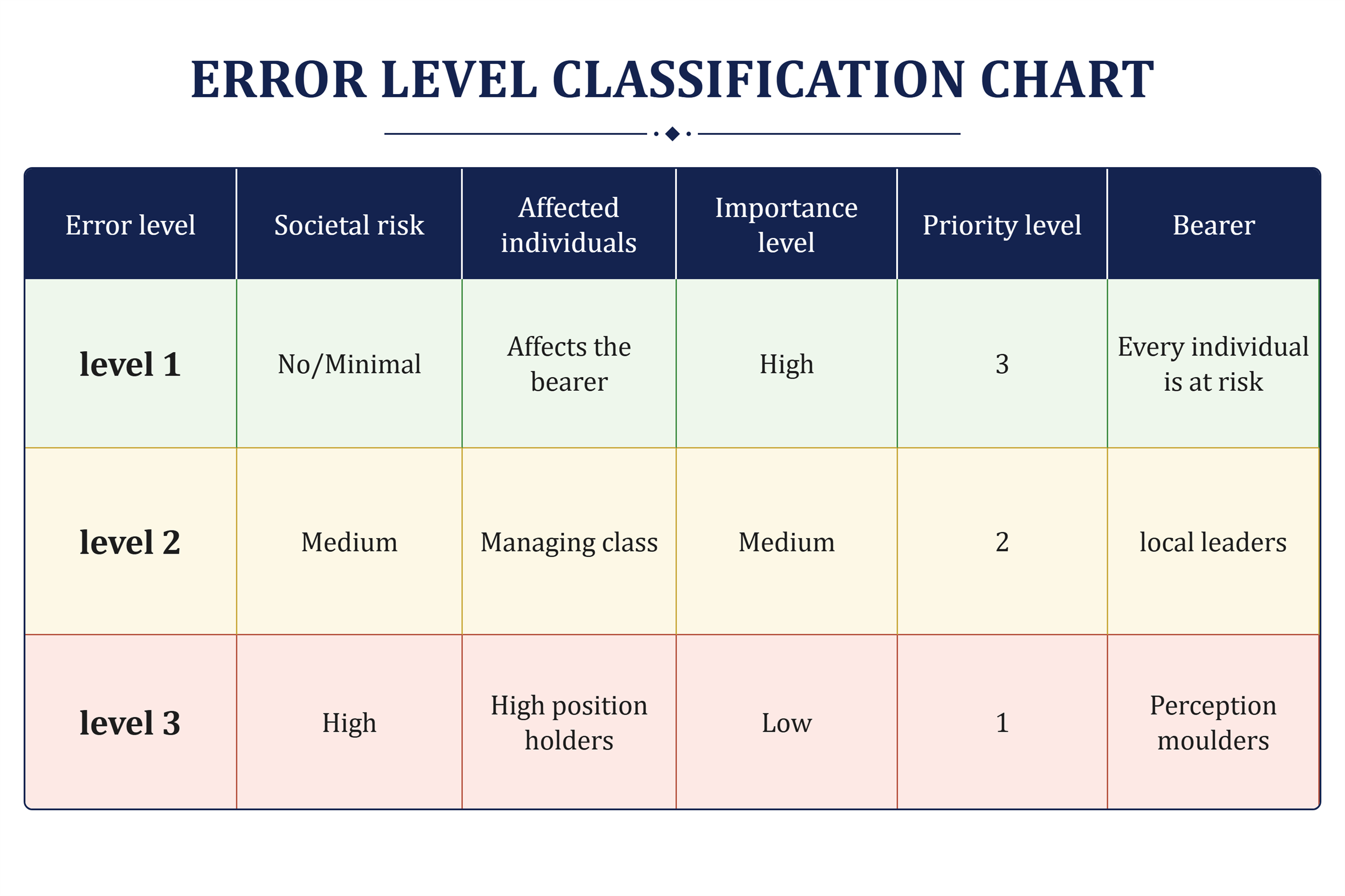
Chart 8